|
Thurso is a Town 110 miles north of Inverness,
furthest north Town in Scotland, in the area of
Caithness.
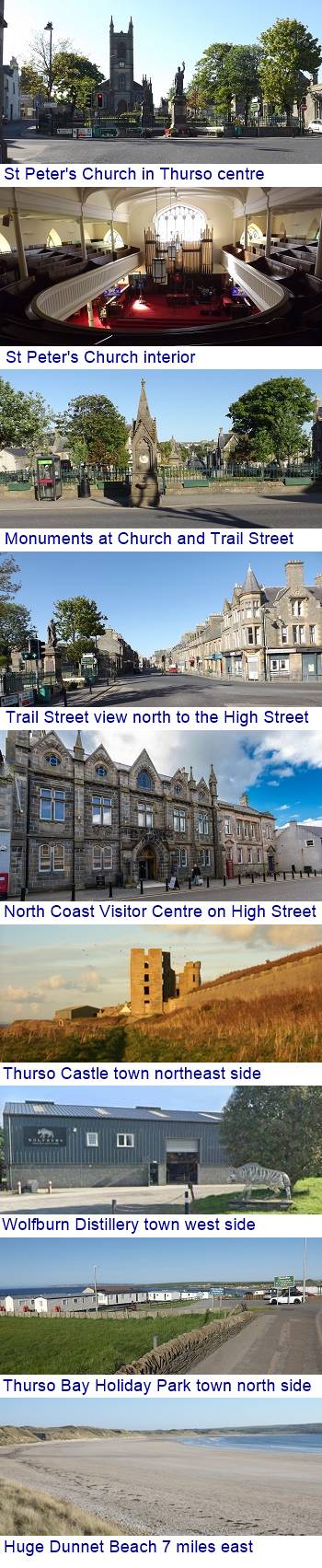
Thurso is popular for the North Coast
Visitor Centre on the High Street, Old St
Peters Church, Thurso Beach and Thurso Castle
Ruins by the harbour, Wolfburn Whisky Distillery on the
west side, Walks, Watersports 7
miles east at the vast Dunnet Beach, and as a
base for exploring the North Coast and Orkney
Islands.
For Images on Mobile swipe right
Click on Map for area Attractions
Camping & Touring Parks in
area
The image top is of St Peter's Church in
Thurso centre with two Monuments in the Gardens
in front of the Church named Sir John's
Square.
Trail Street is one of the the main streets
in the Town with the Royal Hotel being the largest
Hotel on this street.
The North Coast
Visitor Centre is on the High Street, covering
the Vikings, Picts, History of the Dounreay
Nuclear Research, and the Robert Dick
Herbarium. This used to be the Caithness
Museum.
Old St Peter's
Church is on Wilson Lane close to the
Harbour west side, built around 1125 as the
first main Church in the area.
The Ruins of Thurso Castle are on the east
side of the Harbour. This Castle was built from
1665 for the Sinclair's, Earls of Caithness,
More Images by
Wendy at Flickr.
Thurso Bay Holiday
Park is on the northwest side of the Town
with a range of Touring and Camping
Pitches.
There are three Ferries from the area for
trips to the Orkney Isles, with the Northlink Car Ferry
running from Scrabster 2 miles northwest of Thurso
with 90 minute crossings.
Gills
Bay is 16 miles northeast with Pentland Ferries running from
there with 60 minute crossings. This Ferry also
takes cars.
John O Groats is 19 miles northeast
of Thurso with the John O
Groats Ferry offering 40 minute crossings.
This is a passenger only Ferry that also runs
Coach Tours of the Orkney Isles. This service
stopped in 2023 with it being put up for
sale.
Thurso History
23,000 BC - Neolithic Horned Cairns were
built on Shebster Hill
for Burials and Rituals 7 miles southwest of
Thurso.
800s - the Norse / Vikings began taking
control of the Orkney Isles, Western Isles, and
parts of Northern Scotland, leading to many
Battles between Scots and Vikings.
1125? - Old St Peters
Church was built at the west side of Thurso
Harbour.
1140s - the Bishops of Caithness ruled much
of the area from their Castle at Scrabster
under 2 miles northwest of Thurso.
1157 - a timber Fort was recorded as having
been built at Thurso for the Earls of Orkney
and Caithness. These Early Earls
were Norse with Scots Kings allowing them to
control the area, said to be on the east side
of the Harbour.
1260s - King Alexander III began forcing the
Vikings out of Scotland, Western Isles, and
later the Orkney Isles.
1300s - Clan Cheyne, Clan Gunn, and Clan
Keith had taken control of much of the land in
Caithness, with long running feuds between
these Clans.
1379 - Henry I
Sinclair, 9th Baron of Roslin, 7 miles
south of Edinburgh, became the 1st Earl of
Orkney, with the Sinclair's being part Norse,
part Scots, he is claimed by some to have
sailed to America in 1398, almost a century
before Christopher Columbus.
1434 - Sir William Sinclair, 11th Baron of
Roslin, became the 3rd Earl of Orkney.
1455 - Sir William Sinclair became the first
Earl of Caithness to control the area for King
James II. Sir William built Rosslyn
Chapel from 1446 with stone carvings that
resemble American crops like Corn.
Some people believe the Sinclair's burried
the Knights Templar treasure at Rosslyn
Chapel, or may have taken it to North
America in 1398.
1472 - Scotland gained control of the
Orkney
Islands, ending Viking rule, and ending the
Sinclair Earldom of Orkney.
1470s - Castle Sinclair
Girnigoe was built for William Sinclair,
2nd Earl of Caithness by Wick, 32 miles
southeast of Thurso, from where they could
control the area.
1500s - the Fort at Thurso was destroyed by
fire.
1566 - Barrogill Castle was built for the
4th Earl of Caithness, George Sinclair, 14
miles northeast of Thurso.
1649 - Irish led by Donald Macalister
Mullach, attacked Thurso but were defeated in
Battle by locals led by Sir James Sinclair.
Mullach was Killed in the Battle.
1650s - Castle Sinclair Girnigoe was badly
damaged during the Wars of the Three Kingdoms,
falling into ruin soon after.
1665 - George Sinclair, 6th Earl of
Caithness, built a stone Castle on the east
side of Thurso Harbour, said to be where the
wooden Fort was situated.
1726 - Haimer Castle was built about 2 miles
southeast of Thurso for Alexander Sinclair, 9th
Earl of Caithness, little remains today.
1790s - the Sinclair's and Clan Gunn began
moving small scale farmers off their land in
the Caithness area, some to small Croft's on
rocky land by the coast so large scale sheep
farming could begin on the more fertile
land.
1803 - Thomas Telford began building the first Road up from Inverness, with Mail / Passenger Coaches running by 1819.
Before this time, most trade was done by Boats or Pack Horses on old rough trails.
1821 - the Thurso Wolfburn Whisky Distillery
was founded on the west side of Thurso by
William Smith.
1832 - the new St Peter's Parish Church was
built in Thurso centre, probably funded by the
Sinclair's, Earls of Caithness, with Parish
Churches ran by local Elders, leading to the
Old St Peter's Church falling into ruin.
1843 - the first small Free Church was built
in Thurso centre on Traill Street, with these
Churches built to be free from State and
Landowner control.
1860 - the West Free Church was built on
Sinclair Street in Thurso centre after a
dispute in the first Free Church on Traill
Street led to the congregation splitting.
1850 - the Royal Hotel was built on Traill
Street three stories high, with most of the
centre of Thurso built around that time, three
stories high with shops on many of the ground
floors.
1871 - a larger Free Church was built on
Olrig Street in Thurso centre, with the old
Free Church at 12 Traill Street converted to a
TSB Bank, then a Pharmacy.
1872 - the Sinclair Castle on the east side
of Thurso Harbour was rebuilt as a Gothic
Mansion for Sir John George Sinclair, 3rd
Baronet of Ulbster, relation of the Earls of
Caithness.
1874 - the Railway reached Thurso, linking
the Town to Inverness, and from there, the rest
of the UK.
1885 - the Episcopal Church was built on St
George's Street in Thurso, with Bishops. These
Churches were banned in Scotland after the
Reformation of 1560 as the Scots wanted their
Churches run by local Elders, not Bishops
chosen by Royals. Episcopal Churches were built
in Scotland again from the late 1790s.
1889 - George Sinclair, 15th Earl of
Caithness died when he lived at Barrogill
Castle 15 miles northeast of Thurso, with him
being the last Sinclair Earl to live in
Caithness.
1900 - the first Cars began appearing in the Wick area around this time.
1952 - Thurso Castle
was noted as being in Ruin.
1952 - the Queen Mother bought Barrogill
Castle as a holiday home, renaming it Castle of
Mey.
1955 - the Dounreay
Nuclear Power Station was built 10 miles west
of Thurso.
1959 - Thurso Technical College opened, it
is now part of the University of the Highlands
and Islands, said to have about 3,000 full time
and part time students.
1994 - the Dounreay Power Station had its
last Electricity Reactor closed down.
2015 - the last Military Reactor at Dounreay
was closed down. The Site is now being
Monitored and Maintained.
2020s - the Olrig Street Church had plans
made to convert it to a skate park and climbing
centre.
Today - Malcolm
Sinclair, 20th Earl of Caithness, lives in
London England.
See Canisbay Kirk 17 miles east of Thurso
for where the 19 Earls of Caithness are
buried.
|