|
Scrabster is a small Port Village 112 miles
north of Inverness, on the north coast of
Scotland, 2 miles northwest of Thurso, in the
area of Caithness.
Scrabster is popular for the large Northlink Ferry that
runs to the Orkney Islands, 90 minute crossing,
long beach, Diners with views over the Harbour,
and 5 mile Walking Route around Holborn Head
with a Lighthouse, Sea Stacks, and Caves.
For Images on Mobile swipe right
Click on Map for area Attractions
Camping & Touring Parks in
area
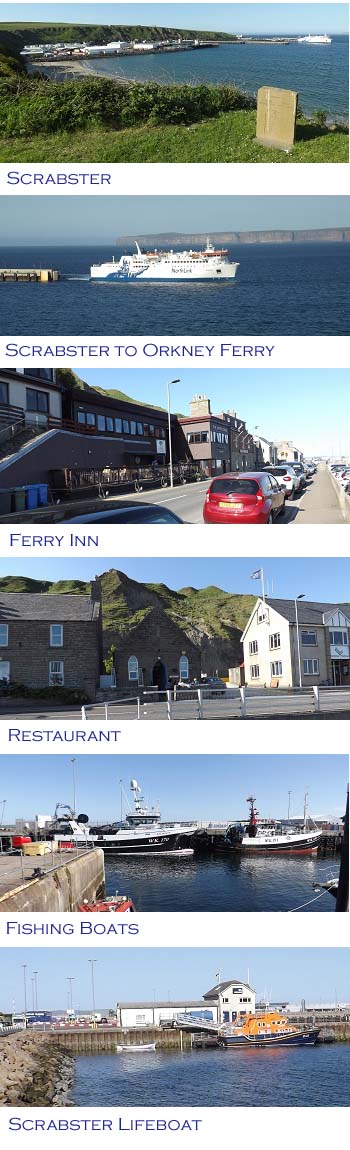
The image top is from a viewpoint next to
the main road down into Scrabster, looking over
the long Beach and Harbour.
The image second top is of the Northlink
Ferry that runs two or three times per day
between Scrabster and Stromness on Orkney, a 30 mile
crossing, second largest town after Kirkwall.
Stromness and Kirkwall are 14 miles apart.
The Ferry Inn is on
the Main Street with the Restaurant having good
views over the Harbour.
The Captains Galley
Seafood Restaurant is also on the Main Street
by the Harbour.
The bottom image is of Scrabster Beach with
Thurso seen under 2 miles east.
The few remains of Scrabster Castle /
Bishops Palace, are on Rocks sticking out onto
the Beach about half of a mile east from the
Scrabster viewpoint, where this image was
taken.
The Castle remains are best visited via a
path out from Thurso Beach.
Scrabster History
800s - the Orkney Islands were taken over by
Norse / Vikings. The Vikings then began trying
to take control of areas on Mainland
Scotland.
Caithness is an area in the far northeast of
Scotland covering 712 square miles.
1140s? - the Bishop of Caithness had a
Castle built at Scrabster above the Beach, to
serve as his Secure Residence, with the Bishops
ruling much of the area.
Most Bishops at that time around Scotland
lived in Castles, as many of them were
un-popular due to their taxes and brutal
treatment of people accused of crimes.
1201 - the Norse Earl of Orkney, Harald
Maddadson, tortured a Bishop at Scrabster
Castle, forcing the Bishop to relocate to
Halkirk 9 miles
south.
1300s - Clan Cheyne, Clan Gunn, and Clan
Keith had gained control of much of the land in
Caithness, with long running feuds between the
Clans.
1379 - Henry I
Sinclair, 9th Baron of Roslin, became the
1st Earl of Orkney as well, with the Sinclair's
part Norse, part Scots through marriage, he is
claimed to have sailed to America in 1398,
before Christopher Columbus in 1492.
The Sinclair's first gained land at Roslin 7
miles south of Edinburgh in the 1200s for their
support of Kings.
1434 - Sir William Sinclair, 11th Baron of
Roslin, became the 3rd Earl of Orkney as
well.
1455 - Sir William Sinclair also became the
1st Earl of Caithness to control the area for
King James II.
Sir William also built Rosslyn
Chapel in 1466, with stone carvings of
Crops like Corn, only found in the Americas at
that time.
Some people think the Sinclair's have the
Knights Templar treasure burried at Rosslyn
Chapel, or took it to North America in
1398.
1472 - King James III of Scotland gained
control of Orkney through a Land Deal with
the Norse, leading to the Sinclair's losing the
Earldom of Orkney.
1470s - Castle Sinclair Girnigoe was built
for William Sinclair, 2nd Earl of Caithness, by
Wick, 23 miles southeast of Scrabster, from
where they would control the area.
1544 - George Sinclair, 4th Earl of
Caithness, gained control of Scrabster
Castle.
1566 - Barrogill Castle was built 16 miles
northeast of Scrabster for George Sinclair, 4th
Earl of Caithness.
1650s - Castle Sinclair
Girnigoe was damaged during the Wars of the
Three Kingdoms when troops of Oliver Cromwell
took the Castle from the Sinclair's, it was in
ruin by 1690.
1665 - Thurso Castle was built 2 miles south
of Scrabster for George Sinclair, 6th Earl of
Caithness.
1726 - Scrabster
Castle was said to be in Ruin.
1790s - Clearances began in the Caithness
area by the Sinclair's and Clan Gunn, moving
small scale farmers off their land, some to
Croft's on rocky land by the coast so large
scale sheep farming could begin on the better
land.
1803 - Thomas Telford began building the first Road up from Inverness, with Mail / Passenger Coaches reaching Scrabster around 1819.
Before this time, most trade was done by Boats or Pack Horses on old trails.
1820 - the first Pier at Scrabster was built
by Thomas Telford at a time the Government were
encouraging the growth of sea fishing around
Scotland, part to create work for people
cleared from their land. The first Steam
Powered Boats began operating around Scotland
at that time as well.
1834 - Scrabster House
was built for a local landowner, next to the
road down into Scrabster, said to be where
there was an earlier Bishops Mansion. The
Mansion is hard to see for trees around it.
1841 - the Scrabster Harbour Trust was
formed, leading to the Harbour being used by
Ships from Mainland Ports such as Aberdeen,
Edinburgh, and Glasgow.
1856 - the first known regular Ferry Service
between Scrabster and Stromness was founded by
John Stanger, using a timber paddle steamer
named Royal Mail for the 30 mile crossing, at
60ft in length, with the Pentland Firth having
real strong currents.
1862 - Holborn Head
Lighthouse was built to help Guide Ships
into Scrabster.
1860s? - a small Chapel was built looking
over the Harbour for fishermen, this is now a
restaurant.
1872 - the Sinclair Castle on the east side
of Thurso Harbour was rebuilt as a Gothic
Mansion for Sir John George Sinclair, 3rd
Baronet of Ulbster, a relation of the Earls of
Caithness.
1874 - the Highland Railway reached Thurso 2
miles east of Scrabster, leading to the Ferries
also serving as Royal Mail Ships.
1892 - the first St Ola
steamship ferry began operating between
Scrabster and Stromness at 135ft long, capable
of carrying 359 passengers and 3 cars that had
to be hoisted on and off. This was when the The
North of Scotland, Orkney & Shetland Steam
Navigation Company took over.
1889 - George Sinclair, 15th Earl of
Caithness, died when living at Barrogill Castle
/ Castle of Mey, with him being the
last Sinclair Earl to live in Caithness.
1951 - the second St Ola ferry entered
service, said to be able to carry 345
passengers and 10 cars.
1952 - Thurso Castle
was in Ruin.
1972 - the St Ola Pier was built at
Scrabster for Roll On Roll Off Ferries after
P&O took over the route.
1974 - the third St Ola, a Roll On Roll Off
ferry, began operating between Scrabster and
Stromness, said to be capable of carrying 400
passengers and 65 cars.
1990s - the Fish Market at Scrabster was
enlarged with Fishing Boats from around Europe
landing their catches such as: cod, haddock,
monkfish, brown crab, European lobster, prawns,
and scallops, with refrigerated trucks able to
deliver them to London in under 24 hours.
1992 - the fourth St Ola at 4,833
gross tons began operating between Scrabster
and Stromness, said to be capable of carrying
500 passengers and 140 cars.
2002 - the new Queen Elizabeth Quay was
built for the Northlink Ferry
named MV Hamnavoe that began running between
Scrabster and Stromness after Northlink took
over the route from P&O.
MV Hamnavoe is 8,780 Gross Tons, 367 feet
long, 61 feet wide, can carry 600 passengers,
and 98 cars, takes about 1 hour 30 minutes to
cross, about 3 times each way most days.
Today - the 20th Earl of
Caithness lives in London England.
See Canisbay Kirk 18 miles east of
Scrabster for where the 19 Earls of Caithness
are buried.
|