|
The Skye Museum of Island Life and Flora
MacDonald Grave are in the northwest of the
Isle of Skye, in the area of Kilmuir, 21 miles
northwest of Portree, 7 miles north of Uig. Open Monday -
Saturday, Easter - late September, 10.00am -
5pm, last entry 4.30pm with an entrance fee,
Kilmuir Cemetery is open at all times.
Postcode: IV51 9UE
For Images on Mobile swipe right
Click on Map for area Attractions
Attractions
List
Camping & Touring Parks in
area
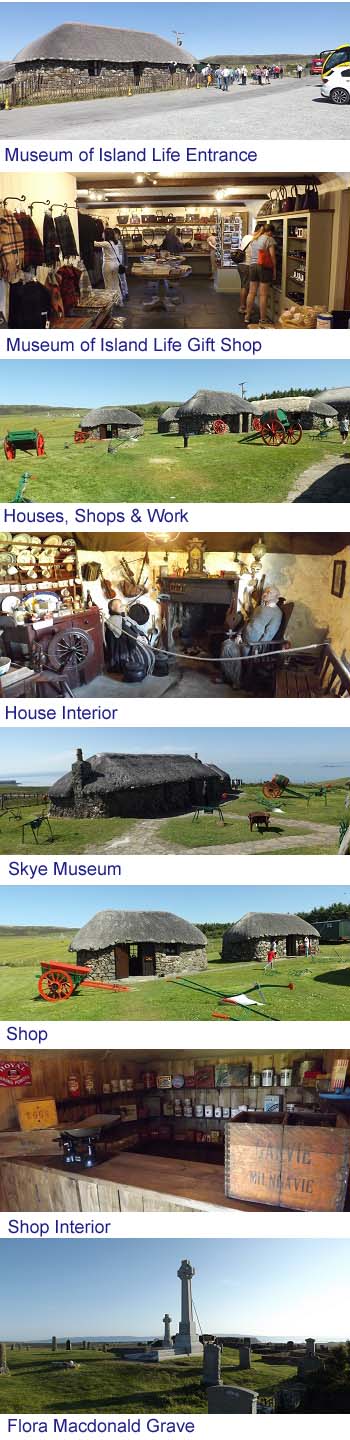
The image top is of the Car Park and
Entrance to the Skye Museum of Island Life.
The second image is of the Shop in the
Museum.
The other images show a number of Thatched
Stone Buildings that were common on Skye and
other Islands for hundreds of years.
The Buildings show a typical Highland
Village, including Homes, Shop, Iron Mongers,
Cobbler, Weavers, and more.
The Buildings at the bottom end of the
complex are used as a Museum, giving
information on Crofting on the Islands,
Jacobite Risings, and Flora MacDonald, the
woman that helped Bonnie Prince Charlie escape
after the Jacobite defeat by Government Troops
at the Battle of Culloden in 1746.
A short walk or drive uphill from the Museum
where there is a good car park, is the Kilmuir Graveyard, Burial Place of
Flora MacDonald, also a Flat Grave Slab of a
Knight, and a more recent Grave of the Scottish
Fashion Designer Alexander McQueen.
An Iron Age Souterrain, an
underground passage from the early medieval
times used for storing food or as a hiding
place, is about 1 mile south at the Hamlet of
Kilvaxter.
Museum of Island Life History
800s - Vikings were in control of Skye and
other North Western Isles.
1100s - the Vikings were being forced out of
the Western Isles by Scottish Kings using Clans
such as MacLeod and MacDonald to keep control
of the area for the Kings, with these Clans
being part Viking.
People at this time lived in Townships, 10
to 30 Families sharing land for growing crops
and rearing animals.
Clan MacLeod built Dunvegan
Castle in the northwest of Skye in the
1200s, 35 miles southwest of this museum, then
Duntulm Castle 2 miles north of this
Museum in the 1300s.
1500s - Clan MacDonald took control of
Duntulm Castle and that area known as the
Kilmuire Estate, after a series of battles with
the MacLeod's.
Clan MacDonald and Clan MacLeod then
continued to fight until the King forced them
to make peace in the early 1600s.
The Chiefs of each Clan owned vast areas of
land with their Castles used to control the
area. People in Townships would pay rent to the
Chief, and most of the men would fight for the
Chief when required. This allowed Highland
Clans to raise large Armies at short
notice.
1500s - England and Scotland began adopting
Protestantism as they claimed the Catholic
religion based on the Pope in Rome needed
reformed.
1689 - the first of a series of Jacobite
Risings began after the Catholic King James
II was overthrown by his Protestant daughter
Mary and her husband William of Orange.
Many Highland Clans fought for the Catholic
Stuart's to be restored to the throne, and many
fought on the side of the Government. Some
would change sides, depending on which side
looked most likely to win.
To fight on a losing side at that time,
could lead to you losing your Castle and
Land.
1746 - the Jacobite's led by Bonnie Prince
Charlie lost for the final time at the Battle
of Culloden. Flora MacDonald
then helped Bonnie Prince Charlie flee to Skye,
then from there make his way to safety in
France. This Romantic Event led to Skye
becoming the most famous of all the Scottish
Islands.
Clan MacDonald and Clan MacLeod of Skye
supported the Government at the time of
Culloden, but remained in Skye, so never fought
at the Battle.
Many other Clan Macdonald and MacLeod, from
other areas, fought for the Jacobite's at
Culloden.
The aftermath of the Battle of Culloden led
to Township people being refused the right to
wear Tartan and own Weapons.
The Highland Clearances began soon after
with Township people being forced off their
land to make way for large scale Sheep Farming,
also, to reduce the population so Risings would
be less likely.
Many people moved to Cities for industry,
Coastal Towns for Fishing that was booming from
that time, or emigrated to North America and
Canada.
Some families were given small plots of
rocky land that became known as Croft's, not
enough to live off, so had to take on seasonal
work such as fishing, seaweed harvesting and
more.
1771 - the first 370 Skye Emigrants sailed
to North Carolina / America with their fares
paid for by their Landowners. They were given
free Land with 10 years free from Tax, although
many struggled as the Land was not always as it
was described.
The trip from Skye to America took 6 - 10
weeks, with disease and malnutrition taking
many lives.
About 17,000 people emigrated from the Isle
of Skye from the 1760s - late 1800s.
1776 - the American War of Independence
broke out as Americans fought to put an end to
British rule in America.
1783 - the American Revolution ended with
Britain losing control. This led to Britain
using Australia as a place to offload people
they believed were trouble makers.
Many Crofters would then be deported to
Australia after being accused of Petty Crimes,
with the best known reason being Sheep
Steeling, with about 8,000 Scots deported to
Australia for theft offences.
1790 - Flora MacDonald died on the Isle of
Skye, with her buried at Kilmuir Cemetery next
to the Skye Museum for Island Life, the Grave
with the largest Memorial Stone.
1855 - Major William Fraser bought Kilmuir
Estate from the MacDonald's. Fraser became
known for being involved in the Highland
Clearances.
1965 - the Skye Museum of Island Life began
by using a Croft from the site since the early
1800s. That Croft had been lived in up to 1957.
More buildings were added over the years to
feature all the Trades in Croft Life around the
1700s and 1800s.
For more large images and interesting
History of Skye, follow this link:
flickr.com/photos/151524482
|