 |
Home Page |
Yom Kippur War: 6 October - 26 October 1973 |
|
The Yom Kippur War was bewteen Arab states led by Egypt and Syria against Israel. The war began with a surprise joint attack by Egypt and Syria on the Jewish holiday of Yom Kippur. Egypt and Syria crossed the cease-fire lines in the Sinai and Golan Heights, that had been captured by Israel in 1967, during the Six-Day War. The Egyptians and Syrians made good advances during the first 24–48 hours, then Israel began hitting back. By the second week of the War, the Syrians had been forced back out of the Golan Heights. The Israelis then attacked two invading Egyptian armies to the south, just as a United Nations cease-fire came into effect. The Arab nations had been humiliated by their defeat during the Six-Day War, so felt they had avengened that defeat with a number of victories early in the Yom Kippur War. This allowed a peace process to follow. The Camp David Accords, led to normal relations between Egypt and Israel, the first time an Arab country had recognized the State of Israel. Egypt, by that time, had been breaking away from their Alliance with the Soviet Union, soon to leave Soviet influence entirely. Israel's casualties at the end of the War were 2,656 killed, about 7,250 wounded. Arab casualties were about 8,528 - 15,000 killed, 19,540 - 35,000 wounded. Israel claim, the IAF lost 102 planes, the
Egyptian Air Force lost 235, and the Syrian Air Force
lost 135. |
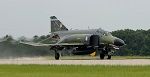
F-4 Phantom II 1960, U.S. / Israel, 1,472 mph 127 Phantoms were in service with the Israeli Air Force at the outbreak of the Yom-Kippur War. In the 18 days of the conflict, Israel Pilots named it the "Phantom's War", with four F-4 squadrons used in most IAF operations. Phantoms shot down about 18 Mig-21s, and 7 Mig-17s during this War. Armed with AIM-9 short-range, heat-seeking Sidewinder missiles, AIM-7 Sparrow medium-range, semi-active radar homing air-to-air missiles, and 20mm guns. |
|
|
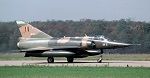
IAI Nesher 1972, French / Israel, 1,460 mph These Aircraft were actually French Mirage 5s crated to Israel to be built, so as to avoid arms embargos with Israel. These Aircraft were credited with over 100 kills to only 14 losses. One Israeli squadron claimed to have downed 59 MiGs to only four Neshers lost. |
|
|
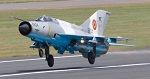
Mikoyan-Gurevich MiG-21 1961, Russian/Arab, 1,385 mph The MiG-21 first faced Israeli Mirage IIICs on the 7th April 1967, when six Syrian MiG-21's were shot down by the Israeli Mirage IIIs. This was a time leading up to the Six-Day War. By the time of the Yom Kippur War, MiG-21s had to face the IAI Nesher that was really a Mirage 5, and the even more advanced F-4 Phantom. MiGs are credited with shooting down about 15 Israeli Aircraft during the Yom Kippur War. Most of the Phantoms lost were to Surface-to-Air Missiles. |
|
|
| Home Page |
|
|