 |
Home Page |
Falklands War: April - June 1982 |
|
Argentine forces invaded the Falkland Islands in April 1982, claiming the Islands belonged to Argentina, as they were situated in Argentine waters. The Falklands had been fought over by the British, French, Spanish and Argentines since their discovery in the 1400s. The British eventually took control of the Islands in 1842, declaring them a British Colony. The reason for the Argentine invasion was: Argentina was in the midst of an economic crisis. Their Governing Military Junta, led by General Galtieri, saw the capture of the Falklands as a way to regain popularity with the people. The Argentine plan seemed to work at first, with the Argentine people celebrating the success of the Invasion. This however was not to last, as they had not taken into account the Prime Minister of Britain (Margaret Thatcher) was also in a position of being so disliked, she was almost certain to be voted out of office at the following Election. Few people at that time thought Britain would send forces to the other side of the world, to fight a War, that in no way they were sure to win. The surrender of the Argentines on the 14th June 1982, resulted in Margaret Thatcher winning the 1983 General Election by a vast margin. Also, her reputation amongst world leaders improved dramatically, with her earning the title (The Iron Lady). Within days of the Argentine surrender, General Galtieri of Argentina was removed from power. He was sentenced to Prison in May 1986 after being found guilty of mishandling the War. The war cost 258 British and 649 Argentine
deaths. |
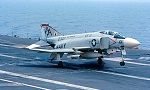
A-4 Skyhawk 1956, US/ Argentine, 673 mph The Argentine Air Force Skyhawks were credited with sinking the Brtish ships HMS Coventry and HMS Antelope, as well as damaging several others. About 22 of Argentina's A-4s were lost during the war, eight shot down by Sea Harriers, mostly with AIM-9L Sidewinder short-range heat-seeking air-to-air missiles. The A-4s were mainly used for bombing British ships, so were not thought to have carried the AIM-9B Sidewinder short-range heat-seeking missiles they were capable of carrying. |
|
|
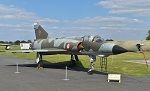
This was Europe's first Fighter capable of Mach 2 speeds, a simple, robust, cheap, and available to any country wanting to buy it. Though designed as a multi-role aircraft, the Argentine Airforce mainly used their Mirage IIIE fighters for air defense and escorts. These Aircraft were armed with two 30mm cannon and AIM-9B Sidewinders, Matra Magic, or Shafrir short-range heat-seeking missiles that could only be launched when directly behind their target. |
|
|
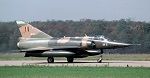
Dagger 1972, Israel/ Argentine, 1,460 mph These Aircraft were actually French Mirage 5s, crated to Israel to be built, so as to avoid arms embargos with Israel. 11 Daggers were lost during the Falklands War, with at least 4 claimed to have been shot down by Harriers with their AIM-9L Sidewinder missiles. Armed with AIM-9B Sidewinders, Matra Magic, or Shafrir short-range heat-seeking missiles that could only be launched from behind their target. |
|
|
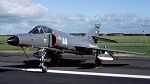
Super Etendard 1978, French/ Argentine, 733 mph Between August and November 1981, five Super Etendards and five Exocet Missiles were transported to Argentina. All five of the Missiles were used during the War, with one Missile sinking the British Destroyer HMS Sheffield, and another sinking the Merchant Ship, Atlantic Conveyor. The Merchant Ship was transporting vital British Fighter Aircraft and Troop Transport Helicopters. Two Missiles were used in each of those attacks. The fifth Missile was launched at the Aircraft Carrier HMS Invincible, but that Missile failed to find its target. |
|
|
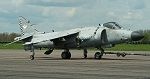
BAE Sea Harrier 1980, British, 734 mph 28 Sea Harriers were operated from the two British Aircraft Carriers, HMS Invincible and HMS Hermes. These Aircraft were used for air defence and ground attack. Sea Harriers were credited with shooting down 21 Argentine Aircraft in air-to-air combat, with no air-to-air losses. Two Sea Harriers were shot down by ground fire, and four lost to accidents. Greater maneuverability, pilot training, and modern AIM-9L Sidewinder short-range heat-seeking missiles with the ability to attack from all directions, including head-on, are said to have contributed to the success of these sub sonic, vertical take off jets. On the 1st of May 1982, 2 sub sonic Harriers shot down 2 super sonic Mirage IIIs, this resulting in the Argentines trying to avoid air-to-air combat from then on. As well as being able to attack from any angle with their superior missiles, the Harriers could basically stop in flight to let the faster Argentine Aircraft fly past, then shoot them down. |
|
|
| Home Page |
|
|